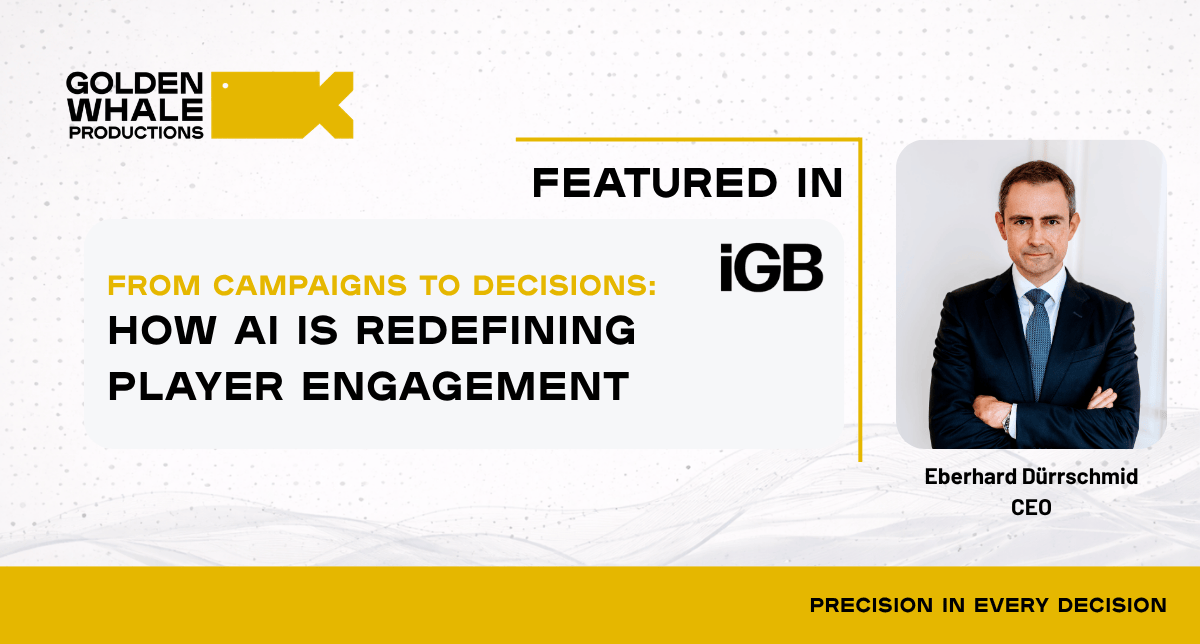
As iGaming moves beyond campaign-driven engagement, operators are shifting towards continuous, real-time decisioning. Static segmentation and scheduled campaigns can no longer keep pace with dynamic player behaviour. The next phase of performance is defined by precision and speed: making the right decision at the right moment, based on live behavioural data.
In a recent conversation with iGamingBusiness, our CEO Eberhard Dürrschmid shares his thoughts on the structural limits of campaign-driven engagement and why this model no longer reflects how players behave today. As player behaviour becomes more dynamic and less predictable, strategies built on predefined segments and scheduled campaigns struggle to keep pace. Instead, the industry is moving towards continuous, data-driven decisioning, where interactions are shaped in real time based on individual behaviour. In this model, success is no longer defined by campaign execution, but by how precisely and how quickly operators can adapt each decision as player behaviour evolves.
For many years, iGaming operators have invested heavily in systems designed to manage player engagement. CRM platforms brought structure to increasingly complex operations, enabling segmentation, campaign orchestration and lifecycle management at scale. These tools solved a real problem, and for a long time, they worked well. But they also defined how the industry thinks about engagement.
Campaigns became the default unit of interaction and segments became the primary way to understand players. Optimisation, on the other hand, became something that happened in cycles, based on historic performance and reviewed after the fact. For many organisations, the structure of the tools dictated the structure of the thinking. However, that model is now starting to show its limits.
The limits of campaign-driven engagement
The issue is not that these systems are obsolete; it is that they are built around a logic that no longer reflects how players behave, or how quickly that behaviour changes. Modern iGaming environments are continuous, shaped by a wider digital landscape where players move more fluidly between platforms, products and channels, often within very short timeframes. Yet many engagement strategies are still built around predefined segments and scheduled campaigns that assume a level of stability that no longer exists.
This is where the role of AI really begins to take shape. The real impact of machine learning is not that it makes campaigns more efficient, but that it removes the need for campaigns as the central organising principle altogether. Instead of structuring engagement around planned activity, operators can move toward continuous, data-driven decisioning that adapts in real time. In this model, the focus shifts from campaign execution to decision quality.
Players do not experience campaigns, they experience interactions, and this distinction is critical. A campaign assumes that a group of players will respond in a similar way over a defined period, but in practice, behaviour is far more dynamic. Two players within the same segment can diverge quickly, reacting differently to timing, incentives or context. As such, static segmentation struggles to capture that complexity.
From segments to real-time decisioning
Machine learning approaches the problem differently. Rather than grouping players and designing campaigns around those groups, models evaluate individual behaviour continuously, determining the most relevant action at any given moment. Segmentation, in its traditional form, gives way to one-to-one decisioning. This shift enables operators to move from reactive optimisation to continuously improving decision-making.
This is where the concept of nudges becomes central to modern engagement. Instead of large, predefined campaigns, engagement is delivered through micro, contextual interactions that align with what the player is already doing. These might be timely incentives, relevant messages or prompts that guide the player naturally through the experience. The key is that they are not imposed as external interventions, they are gently integrated into the flow of the product.
This shift from campaigns to nudges is not just a tactical change; it reflects a deeper structural transformation. When decision-making is driven by continuously learning models, certain parts of the traditional engagement stack begin to lose their central role. Segmentation becomes dynamic and automated. Campaign planning becomes less dominant as interactions are triggered in real time. Manual optimisation – once a core operational function – is reduced as machine learning systems make constant micro-adjustments based on incoming data.
AI reshaping the decision layer
In this sense, AI does not simply optimise the existing model, it changes the model itself. Importantly, this does not require operators to dismantle their existing infrastructure. In most cases, AI is introduced as a decision layer that sits alongside, or on top of the current stack. Core systems, including communication platforms, data warehouses and player account management systems, continue to perform their roles. What changes is where decisions are made, and this shift has immediate implications for how teams work.
In traditional environments, a significant amount of manual resource is focused on planning customer journeys, building campaign logic and managing segmentation structures. These activities are time-consuming and often constrained by the capabilities of the tools themselves.
As decision-making becomes model-driven, that emphasis begins to change. Teams spend less time configuring journeys and more time defining strategy. Creative production becomes more important, as the quality and relevance of individual interactions becomes a key driver of performance. Rather than manually optimising campaigns, teams define the parameters and boundaries within which models operate, ensuring that engagement aligns with commercial and regulatory objectives. The value of the team does not diminish, it shifts.
The operational impact of this transition is often visible very quickly. One of the first changes is the move from historic to predictive decision-making. Instead of analysing past performance to inform future campaigns, operators begin to act on forward-looking insights generated in real time. Engagement becomes more precise, more timely and more aligned with individual player behaviour.
This has a direct effect on performance. Retention typically improves first, as players receive more relevant interactions. Incentive allocation becomes more efficient, reducing unnecessary spend while increasing effectiveness. In many cases, this also addresses the underlying inefficiency of traditional systems, where only a fraction of incentives are deployed optimally. At the same time, automation reduces operational burden, allowing teams to scale without increasing complexity. These outcomes are not driven by doing more; they are driven by making better decisions.
Redefining the engagement stack
Over the next two to three years, the structure of the engagement stack is likely to continue moving in this direction. Rather than a linear process built around campaign cycles, the future model is closer to a continuous loop. Content and communication layers enable interaction across channels, while decision-making is handled by machine learning systems that evaluate behaviour in real time. These decisions are executed instantly through delivery mechanisms, with measurement feeding back into the system to allow models to adapt continuously. The result is an iterative, responsive and self-improving process.
In that context, the role of traditional CRM platforms becomes more focused. They continue to provide execution capabilities, communication channels and orchestration tools. But they are no longer the primary drivers of decision-making. That role shifts to a dedicated intelligence layer that operates across the entire engagement ecosystem.
Ultimately, this transformation is not about choosing between alignment and technology, but about bringing the two together. Operators are moving toward a model where engagement reflects how players behave, rather than how systems are structured, with decisions made continuously and interactions becoming more relevant. Once that alignment is in place, the focus shifts to execution, where the ability to make precise decisions and act on them quickly becomes critical.
In a marketplace where competitors are adopting similar approaches, speed and precision in decision-making will define those who are able to sustain a performance advantage.
#GoldenWhale #iGaming #PlayerEngagement #DecisionIntelligence #PlayerRetention