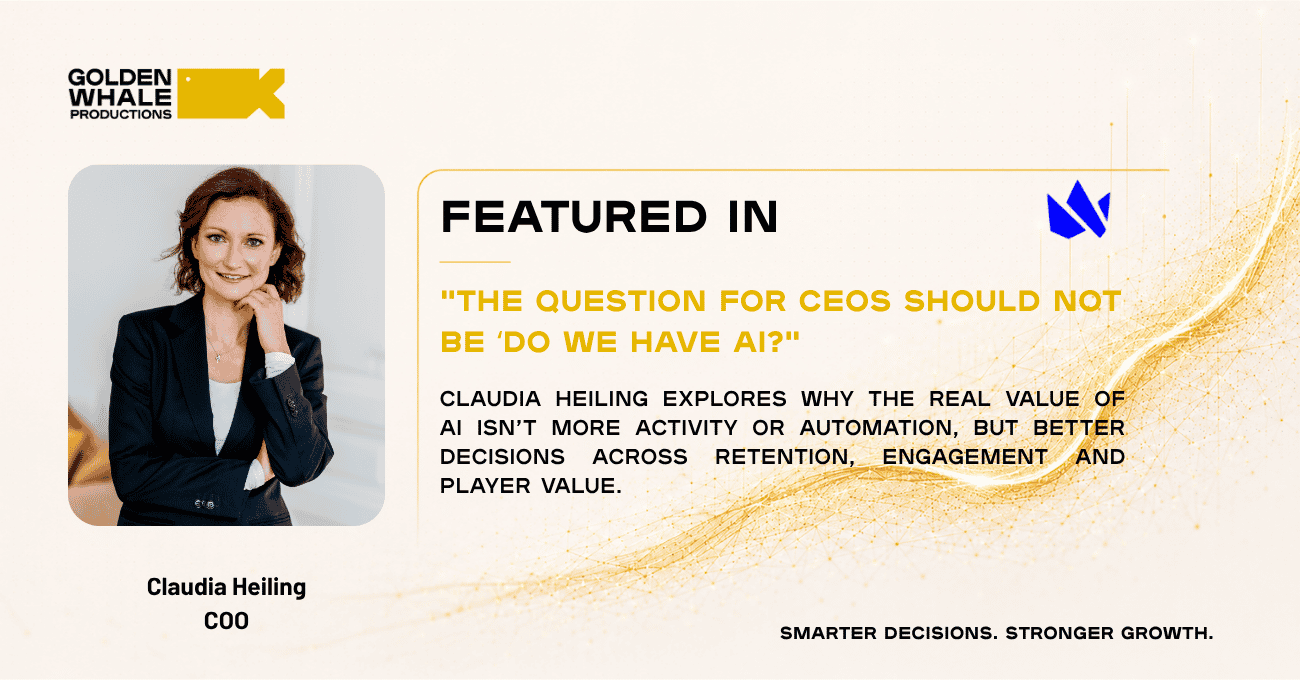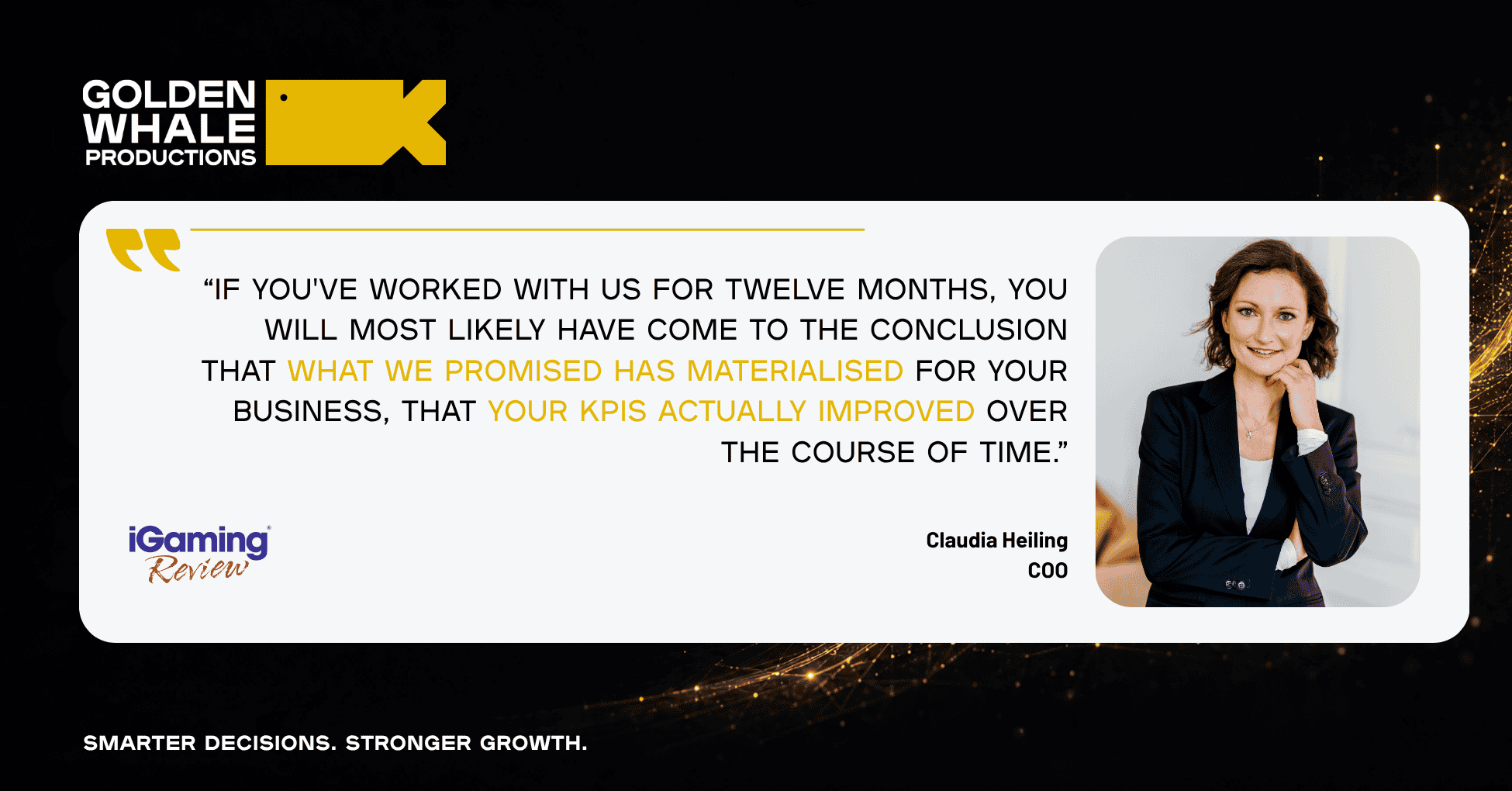
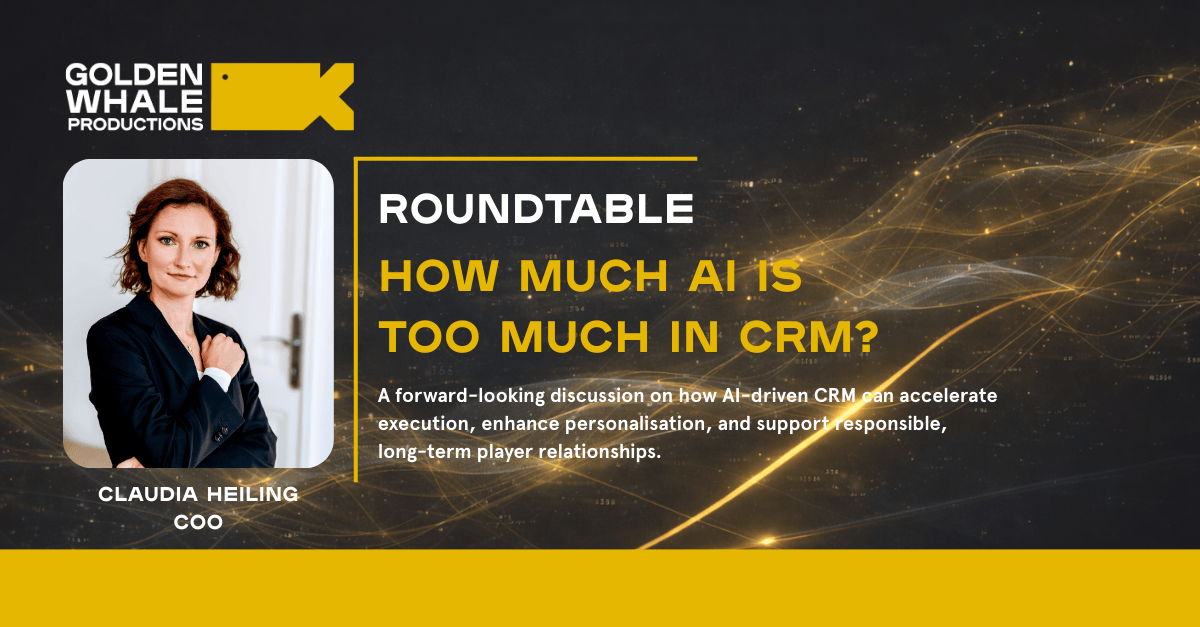
"As personalisation technology becomes more advanced, the competitive edge will increasingly come from the human side of CRM", says Claudia Heiling, COO
Golden Whale’s COO Claudia Heiling recently joined iGaming Republic’s roundtable on how AI accelerates player engagement, where personalisation crosses into intrusion, and why trust beats activity.
To explore this, threee industry leaders joined this How much AI is too much in CRM? roundtable:
- Claudia Heiling, COO and Co-Founder at Golden Whale
- Shireen Haddadeen, Founder at Animation Imagination
- Alec Gehlot, CEO and Founder at PlaySignal
The economics of iGaming player acquisition have fundamentally changed. With costs through the roof and competition intensifying across every market, operators can no longer rely on aggressive bonusing and broad-reach campaigns to build sustainable revenue.
The answer increasingly lies in smarter, faster, more responsive engagement systems that treat each player as an individual journey rather than a conversion target. AI-driven CRM and gamification have moved from experimental cases to operational necessities, enabling operators to deliver personalized experiences at scale while maintaining the guardrails that protect both players and brands.
But the promise of AI in CRM brings new tensions.
- How do operators accelerate campaign cycles without losing control?
- Where is the line between helpful personalization and intrusive manipulation?
- And how can responsible gaming evolve from a compliance checkbox into an intelligence layer that actively shapes engagement strategy?
These questions are no longer theoretical. They’re defining how the next generation of operators will compete, retain players, and earn the trust required to operate in increasingly scrutinised markets.
iGaming Republic: How can AI be applied ethically across the customer journey, and where should operators draw clear boundaries between effective personalisation and player intrusion?
Claudia Heiling: Ethical AI starts with transparency. Players should understand that personalisation is taking place and why it benefits their experience, whether through more relevant content or better-timed offers.
The second key element is balance. Optimisation systems should never operate in isolation, but alongside responsible gaming frameworks that act as a limiter when necessary. This ensures that engagement strategies support sustainable play rather than purely short-term activity.
Clear boundaries should be drawn around sensitive data use, excessive frequency, and behavioural patterns that indicate risk. When AI is combined with strong RG tools and clear internal policies, personalisation becomes a way to improve player experience responsibly, not a method of pushing engagement beyond what is healthy or appropriate.
iGaming Republic: How can operators use AI within CRM to shorten campaign build, testing, and launch cycles without increasing operational risk?
Claudia Heiling: AI and machine learning allow operators to shift from manually configuring campaigns to systems that adapt automatically to where each player is in their journey. Instead of building static segments and testing them one by one, AI can evaluate player behaviour in real time and match the right promotional message or incentive to the right moment. This drastically reduces the time between idea and execution.
At the same time, risk can be controlled through guardrails and continuous measurement built into the system. The focus should move from “running CRM software” to actually delivering relevant CRM experiences. AI provides the decision quality needed to accelerate execution without sacrificing oversight, consistency, or responsible engagement standards.
iGaming Republic: What is the most overlooked or underutilised CRM strategy in iGaming today, and why are many operators failing to extract value from it?
Claudia Heiling: Many operators are still locked into campaign-centric thinking, where success is measured by the performance of individual promotions rather than the overall player journey. This approach made sense when CRM tools were largely manual, but AI now allows us to think differently.
Instead of sending isolated campaigns, operators can build “nudge-focused” journeys that guide players through a more varied and natural experience. These journeys respond continuously to behaviour, adjusting communication, incentives, and timing as the relationship evolves. The missed opportunity lies in failing to connect touchpoints into a cohesive lifecycle strategy. Operators who still treat CRM as a series of one-off pushes often overlook the compounding value of small, well-timed interactions that build trust, loyalty, and long-term engagement.
iGaming Republic: Is there a difference in how legacy sportsbooks and casinos versus new crypto casinos and social platforms approach player engagement, and what can each learn from the other?
Claudia Heiling: Yes, there are clear differences. Legacy operators often have much more experience in compliance, risk management, and long-term customer value, which leads to more structured and sustainable engagement models.
Newer crypto casinos and social platforms, on the other hand, tend to be faster-moving, more experimental, and highly focused on community dynamics and real-time interaction. They often move faster when testing new features, build stronger community interaction, and adapt player experiences quickly based on feedback.
The opportunity lies in combining these strengths. Traditional operators can learn from the agility and community-driven engagement of newer platforms, while crypto and social operators can benefit from the lifecycle thinking, responsible engagement practices, and data discipline that established brands have developed over years in regulated markets.
iGaming Republic: Outside of AI and technology platforms, what CRM trends do you expect to shape player engagement strategies in 2026, and how should operators prepare for them today?
Claudia Heiling: As personalisation technology becomes more advanced, the competitive edge will increasingly come from the human side of CRM. Creative quality, tone of voice, brand consistency, and trust-building communication will become more important differentiators.
Players will respond not just to relevance, but to how brands make them feel over time. Operators should invest now in stronger creative processes, better storytelling, and clearer brand positioning, supported by technology that amplifies these efforts. AI can optimise delivery, but meaningful engagement will depend on combining smart automation with thoughtful, human-centred communication strategies.
Read the full article here.
#roundtable #AI #ethics #igaming #goldenwhale